End of Life
Hospice care at home What actually happens, and how families navigate it
Updated September 2026
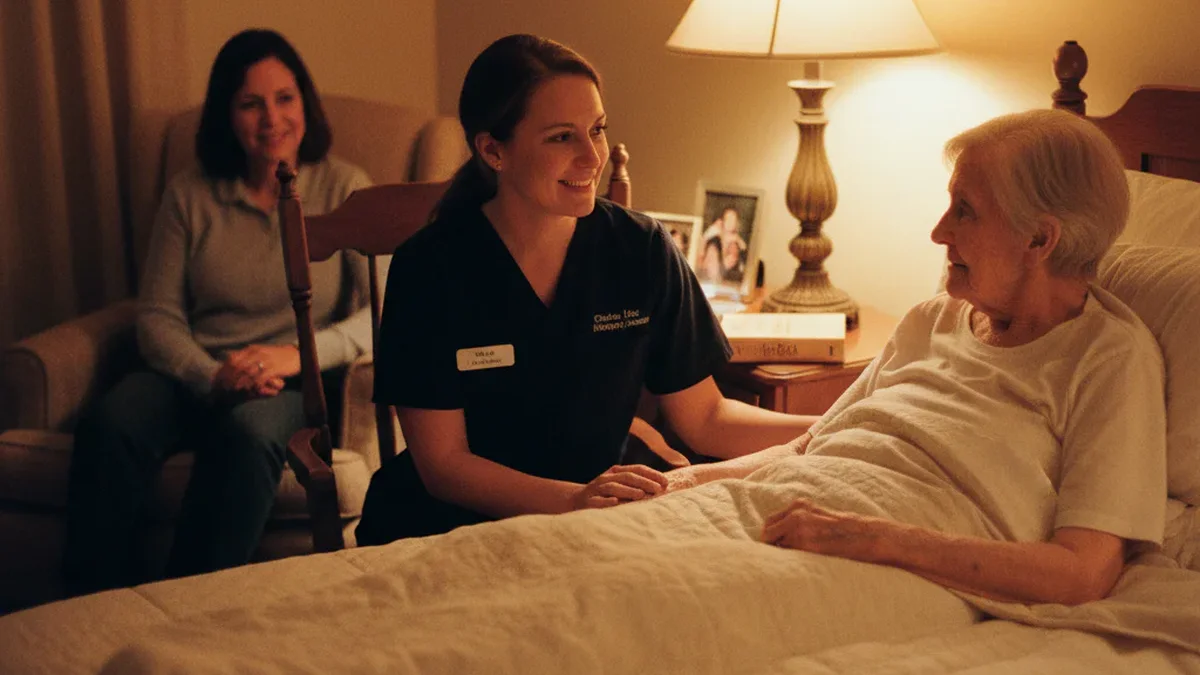
Article images are AI-generated illustrations. Some may include AI-generated people; they are illustrative and do not depict real caregivers, patients, experts, or FamilyCareWise contributors.
TL;DR: Hospice is not giving up. It shifts the goal of care from cure to comfort, and most families could have started sooner than they realize. At home, a nurse, aide, social worker, and chaplain manage pain and symptoms, on call day and night.
Home hospice brings a nurse, aide, social worker, and chaplain to the house and is covered by Medicare for a six-month-or-less prognosis. What the team does, what Medicare pays for, and what families are told to expect.
If your parent or loved one has just been referred to hospice, you are probably holding two things at once: grief at what the referral means, and a need to understand what actually happens next. The word carries weight. Many families hear it and feel like they are being asked to give up. What hospice actually is, and what daily life with it looks like, is usually different from what families expect before they experience it.
What hospice care actually is
The National Institute on Aging (NIA) describes hospice as care focused on comfort, care, and quality of life for a person with a serious illness who is approaching the end of life. The person beginning hospice understands that the illness is not responding to attempts to cure it or slow its progress. Attempts to cure the illness stop, and the effort shifts to managing pain, controlling symptoms, and supporting the person and family through whatever time remains.
Stopping curative treatment does not mean stopping all medical care. The Medicare hospice benefit covers care and services related to the terminal diagnosis, and other Medicare-covered care for unrelated conditions continues as usual. NIA gives the plain example: if a person with cancer also has high blood pressure, hospice covers the cancer-related care while the blood pressure medicine continues.
NIA also reports a comparison worth knowing before this decision feels irreversible. Families of people who received hospice care are more satisfied with end-of-life care than families who did not. Hospice recipients are also more likely to have their pain controlled, and less likely to undergo tests or be given medicines they don't need, compared with people who did not use hospice.
For a broader look at how hospice fits into the care options available to families, our guide on how hospice care works covers the full range of settings and decision points.
Who qualifies for home hospice
To qualify for the Medicare hospice benefit, Medicare.gov lists three conditions. The hospice doctor and the person's regular doctor, if they have one, must certify a life expectancy of six months or less if the illness runs its natural course. The person must accept comfort care instead of care to cure the illness, and must sign a statement choosing hospice instead of other Medicare-covered treatment for that illness. That signed document is called the Hospice Election Statement, and Medicare.gov specifies it must be completed before any hospice services begin.
Hospice is not limited to cancer. NIA lists heart failure, COPD, dementia, Parkinson's disease, and many other serious conditions as qualifying illnesses. If a physician has said curative treatment is no longer effective, or that the person is declining despite treatment, it is worth asking whether a hospice evaluation makes sense.
You can still see your regular doctors. Medicare.gov confirms that care for problems unrelated to the terminal illness stays covered the usual way. Hospice providers must also give you a list, on request, of items and drugs they have determined are unrelated to the terminal diagnosis, along with the reason why.
The hospice team: who comes to the home
NIA describes home hospice as bringing together a team with special skills: nurses, doctors, social workers, spiritual advisors, and trained volunteers, all working with the person, the caregiver, and the family. Each member plays a distinct role.
Registered nurse
The RN is the clinical backbone of home hospice. Visits typically happen several times a week, more often as the person declines. The nurse assesses symptoms, manages medications, educates the family on what to watch for, and is usually the main clinical contact between the family and the rest of the team.
Home health aide
Aides assist with bathing, personal hygiene, and basic comfort care, typically several times a week, not daily. The family, or a hired private caregiver, handles day-to-day personal care between aide visits.
Social worker
The social worker helps the family navigate practical and emotional challenges: family communication, community resources, financial questions related to the death, and connecting family members to counseling or support groups.
Chaplain
The hospice chaplain provides spiritual support, not religious instruction. Families of any faith background, or none, can use it. The chaplain can help a person process what they are facing, facilitate family conversations, and support caregivers struggling with their own fears.
Hospice physician
A hospice medical director oversees the plan of care and is available for clinical consultation, usually communicating with the nursing team rather than making regular home visits, though visits can be arranged when needed.
24/7 phone support
NIA notes that a member of the hospice team visits regularly, and someone is usually available by phone 24 hours a day, seven days a week. If a symptom becomes alarming at 2 a.m., the family calls that number and speaks to a nurse. The nurse can advise over the phone or arrange for someone to come. Family caregivers consistently name this as one of the most valued parts of home hospice.
What the family provides
Hospice is a partnership. The agency provides the clinical team, the medications, and the equipment. NIA is direct about the rest: the day-to-day care of a person dying at home is provided by family and friends, and the hospice team coaches family members on how to care for the dying person.
Most hospice agencies require a primary caregiver be identified, a family member, friend, or hired caregiver present in the home who can meet basic needs between visits. That person needs no medical training. They check on the person, help with meals and comfort, give oral medications, and call the hospice team when something changes.
If the primary caregiver needs a break, Medicare.gov confirms the hospice benefit includes short-term inpatient respite care, arranged by the hospice team, to give family caregivers rest. The official Medicare Hospice Benefits booklet (CMS Product No. 02154, March 2026) says you can stay up to five days each time you get respite care. You can get it more than once, but only on an occasional basis. You pay up to 5% of the Medicare-approved cost, capped at the inpatient hospital deductible amount. This is underused and worth asking about.
The comfort kit
One of the most practical things a home hospice agency provides is a comfort kit (sometimes called an emergency kit). It is a small, pre-selected supply of medications the hospice agency delivers to the home in advance, before they are urgently needed, typically covering pain, anxiety or agitation, nausea, breathing difficulty, and noisy secretions.
The medications sit in the home, unused, until a symptom develops. When something happens overnight, the nurse on the on-call line can walk a caregiver through using the correct medication from the kit instead of calling 911, which can trigger an unwanted hospital transfer. The kit manages distress that would otherwise go uncontrolled.
What Medicare covers, and what it does not
Under the Medicare hospice benefit (Part A), you pay nothing for hospice care from a Medicare-approved hospice provider. Medicare.gov lists a copay of up to $5 for each prescription for outpatient drugs for pain and symptom management, and up to 5% of the cost for inpatient respite care. That is close to the full extent of what a family pays.
What Medicare hospice does not cover, per Medicare.gov: treatment intended to cure the terminal illness, and prescription drugs meant to cure it rather than manage symptoms. It also does not cover hospice-type care from a provider other than the one you chose. Room and board is not covered either, whether you live at home, in a nursing home, or in a hospice inpatient facility. If your hospice team determines you need inpatient hospital care and does not arrange it, you could be responsible for the full cost, so any hospital stay should go through the hospice team first.
Coverage runs in defined stretches. Medicare.gov states that eligible enrollees get two 90-day hospice benefit periods, followed by an unlimited number of 60-day periods. Each renewal requires the hospice doctor to recertify, after a face-to-face meeting, that the person is still terminally ill. You also have the right to change your hospice provider once during each benefit period, and to request an addendum listing any items or drugs your hospice will not cover because they are unrelated to the terminal diagnosis.
Medicaid hospice benefits follow a similar structure for eligible recipients, and most private insurance plans also cover hospice, often mirroring Medicare's benefit design. The hospice agency's intake coordinator will walk through your specific coverage before services begin.
What happens as death approaches
As death nears, the body goes through a series of changes, and hospice nurses are trained to prepare families for what is coming so it feels understood instead of alarming. Our guide on the signs death is near walks through the physical changes in detail. In general, visit frequency increases as these signs appear, and the on-call team stays aware, so the nurse can tell family members what to watch for and help decide when to gather relatives who want to be present.
Many people ask whether a dying person is in pain during this phase. The comfort kit exists for exactly this reason. If there are signs of distress, restlessness, labored breathing, or facial grimacing, the nurse guides the family on using comfort medications. The goal is a peaceful death, free from suffering.
When death occurs at home
When your loved one dies at an expected time, the first call goes to the hospice nurse line, not 911. Calling 911 after an expected death at home can trigger an automatic investigation, and the hospice team guides families to avoid it. A nurse will come to pronounce the death and contact the physician for the death certificate. There is no rush to call the funeral home; families can take time to say goodbye before the body is moved.
Most hospice agencies ask families to identify a funeral home in advance, during admission, so the family only has to make one call when they are ready. After the death, the hospice social worker follows up, and bereavement support continues for the family. Grief after caregiving is its own process, and hospice agencies are required to support families through it.
Common misconceptions families have going in
Hospice is not giving up
Choosing hospice means acknowledging that the illness is terminal and that aggressive treatment has become more burden than benefit. It shifts the fight toward comfort, presence, and a peaceful death instead of a traumatic one.
Hospice does not mean death is imminent
The six-month prognosis is a threshold for eligibility, not a countdown. Medicare's own benefit structure, two 90-day periods followed by unlimited 60-day periods, is built for people who live longer than that first estimate. Some people improve enough to be discharged from hospice, and they can re-enroll later if their condition declines again.
You can still see your regular doctors
Hospice covers care related to the terminal diagnosis. For anything unrelated, your loved one's regular Medicare benefits and usual doctors stay available. Hospice does not cut off access to the rest of the medical system.
If your family is still in the earlier stages of planning for what is ahead, our article on advance directives covers the legal documents that make hospice care go more smoothly for everyone involved. Ask the hospice intake coordinator to walk through what is and is not covered before you sign the election statement.
Frequently Asked Questions
Does choosing hospice mean giving up?
No. Hospice shifts the goal of care from curing the illness to comfort. The National Institute on Aging describes hospice as care focused on comfort and quality of life once curative treatment is no longer working or wanted, and it notes that families who use hospice are more likely to have pain controlled and less likely to get tests or medicines they don't need, compared with people who did not use hospice care.
What does hospice provide at home?
Under the Medicare hospice benefit, the hospice agency provides a nurse, a home health aide for personal care, a social worker, and a chaplain. It also provides physician oversight, a phone line staffed 24 hours a day, seven days a week, and all medications and equipment related to the terminal diagnosis. The National Institute on Aging adds that the hospice team coaches family members on day-to-day care between visits.
How do you qualify for hospice care?
Medicare.gov states that a hospice doctor and the person's regular doctor, if they have one, must certify a life expectancy of six months or less if the illness runs its natural course, and the person must sign a statement choosing hospice instead of other Medicare-covered treatment for that illness. Hospice is not limited to cancer; heart failure, COPD, dementia, Parkinson's, and other serious conditions qualify.
Can hospice be stopped if the person improves?
Yes. Medicare.gov confirms a person can leave hospice care at any time and resume Medicare-covered treatment for the illness. If the person later no longer meets the six-month prognosis, hospice can end and the person can re-enroll if their condition declines again. Leaving hospice does not affect any other Medicare benefit.
The information on this page is for educational purposes only and does not constitute medical, legal, or financial advice. Every family's situation is different. Please consult a qualified healthcare provider, licensed attorney, or certified financial planner for guidance specific to your circumstances.